The AI Reflex

People cannot see their own transformation.
Anthropic asked 1,250 professionals whether AI augments or automates their work. Two thirds answered augmentation, insisting the machine only helps. The logs told a simpler story: nearly half the output was machine generated. The sixteen point gap is not deceit. It is amnesia brought on by repetition.
Perplexity tracked the forgetting in real time. Across hundreds of millions of Comet Assistant interactions in 2025 they watched users begin with movie picks and travel routes, then tip into debugging code, analyzing financial data, synthesizing research. Once the agent handles real work, casual use dies. Productivity tasks show the highest retention. By December, 57 percent of all agent minutes were cognitive labor: 36 percent productivity and workflow, 21 percent learning and research. The reflex is not a preference. It is a migration.
Six months ago I was lucky to push one git commit every week. Now I average three a day, fifteen on a good Tuesday. Yes, the models improved, but that is not why my commit graph changed. I built a reflex. I stopped deciding whether to use AI and started reaching for it the way I reach for a light switch. The better models enabled the transformation. The reflex made it automatic.
Anthropic calls the off loaded labor "identity incongruent" work, the hours that were never the job. A pastor in the sample told researchers, It frees me up to be with the people, the part of my job that actually matters. He remembers using AI for research and admin. The illustrative log shows the model could have drafted two thirds of the sermon. The distinction between augmentation and automation collapses when the motion becomes reflex.
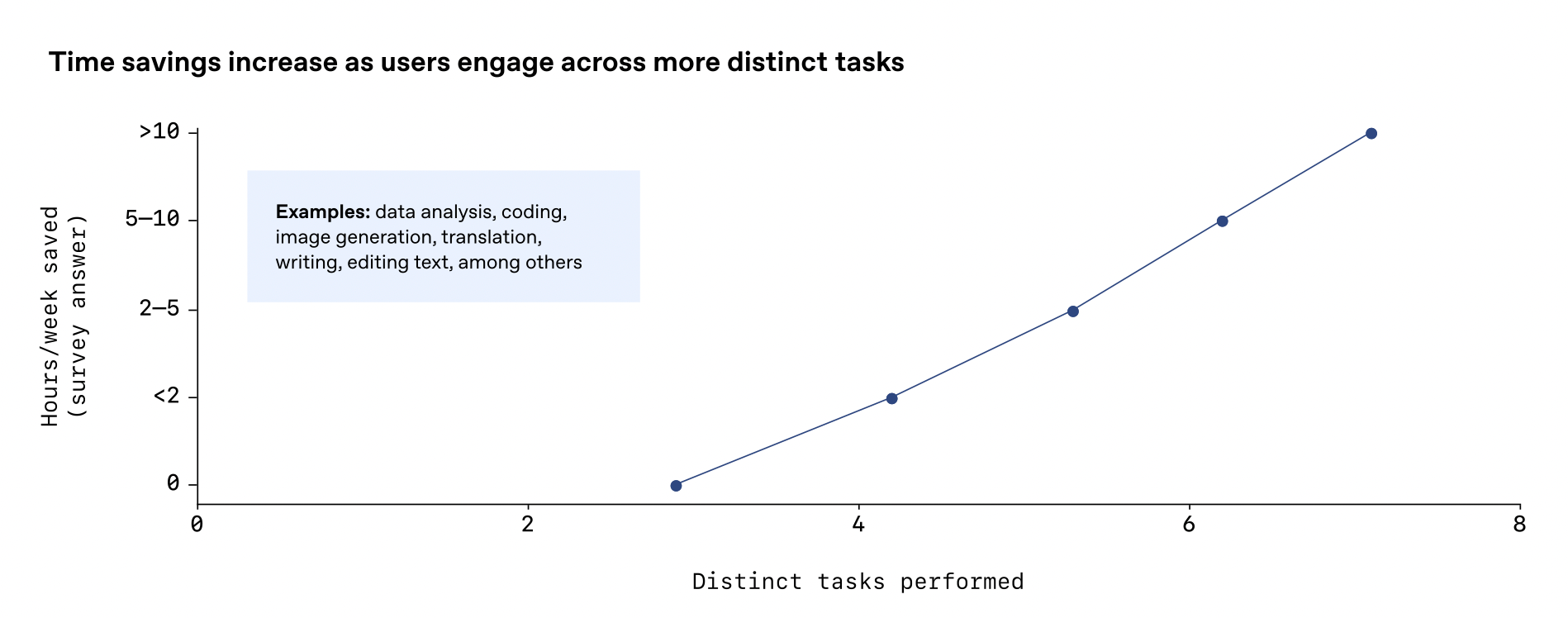
OpenAI’s enterprise warehouse shows the cliff. Workers who weave AI into seven or more task types save five times as much time as workers who stop at four. Not 75 percent more. Five fold. The seventh task is not exotic; it is the one that makes the workflow a single continuous gesture.
Frontier users, the top decile by message volume, send six times as many prompts and invoke data analysis tools sixteen times as often as the median. Price barely budges the curve. A ten percent drop in token cost lifts usage by half a percent. Claude holds 60 percent of programming spend on OpenRouter despite costing multiples of some competitors. DeepSeek pulls huge volume at one fifth the price. Both win because they fit the reflex, not the budget.
OpenRouter analyzed 100 trillion tokens across 2025. Most cohorts decay to near zero by month three. The exceptions are users who adopted a flagship model inside its first three weeks. These users found a workflow the model could solve that previous versions could not.
The June 2025 Gemini 2.5 Pro cohort still retains 40 percent after five months. The May 2025 Claude 4 Sonnet cohort shows the same stickiness. The July 2024 GPT 4o Mini cohort never decayed at all. After that early window, switching means relearning how to swallow.
Programming queries illustrate the crossing. They were 11 percent of OpenRouter traffic in January 2025, over 50 percent by December. Not because more people started coding, but because developers who spent the year putting in reps hit the reflex threshold in bulk.
Asia rose from 13 percent to 31 percent of global usage. Chinese open source models went from negligible to 13 percent of weekly tokens. The catalyst was not model access; it was permission to experiment openly, which shortened the loop between first use and reflex.
Yet most workplaces still treat AI as an adoption problem. Sixty nine percent of workers in the Anthropic study report social stigma. A fact checker hides her process from AI hate colleagues. The highest productivity cohort is the least visible. Companies ran 2025 pilots while frontier workers trained in private. Muscle memory formed underground, without documentation or knowledge transfer.
The hard news for the C suite is that reflex time cannot be procured. OpenAI’s data shows a clean threshold. Below five integrated task types you get incremental gains. Above seven you unlock a different operating regime. Crossing that line takes continuous reps under real load, something purchase orders cannot accelerate.
We crossed the threshold one commit, one sermon, one unnoticed keystroke at a time. The logs hold the proof. Our explanations lag behind. While companies debate governance, the real metric keeps ticking somewhere else, in fingers that no longer pause before invoking the ghost. You cannot survey your way to that lead. You can only discover you have already lost it.